
Case Study
OpenDM
A paid inbox, working end to end in five weeks — a public email address that pays you to read your mail.
About OpenDM
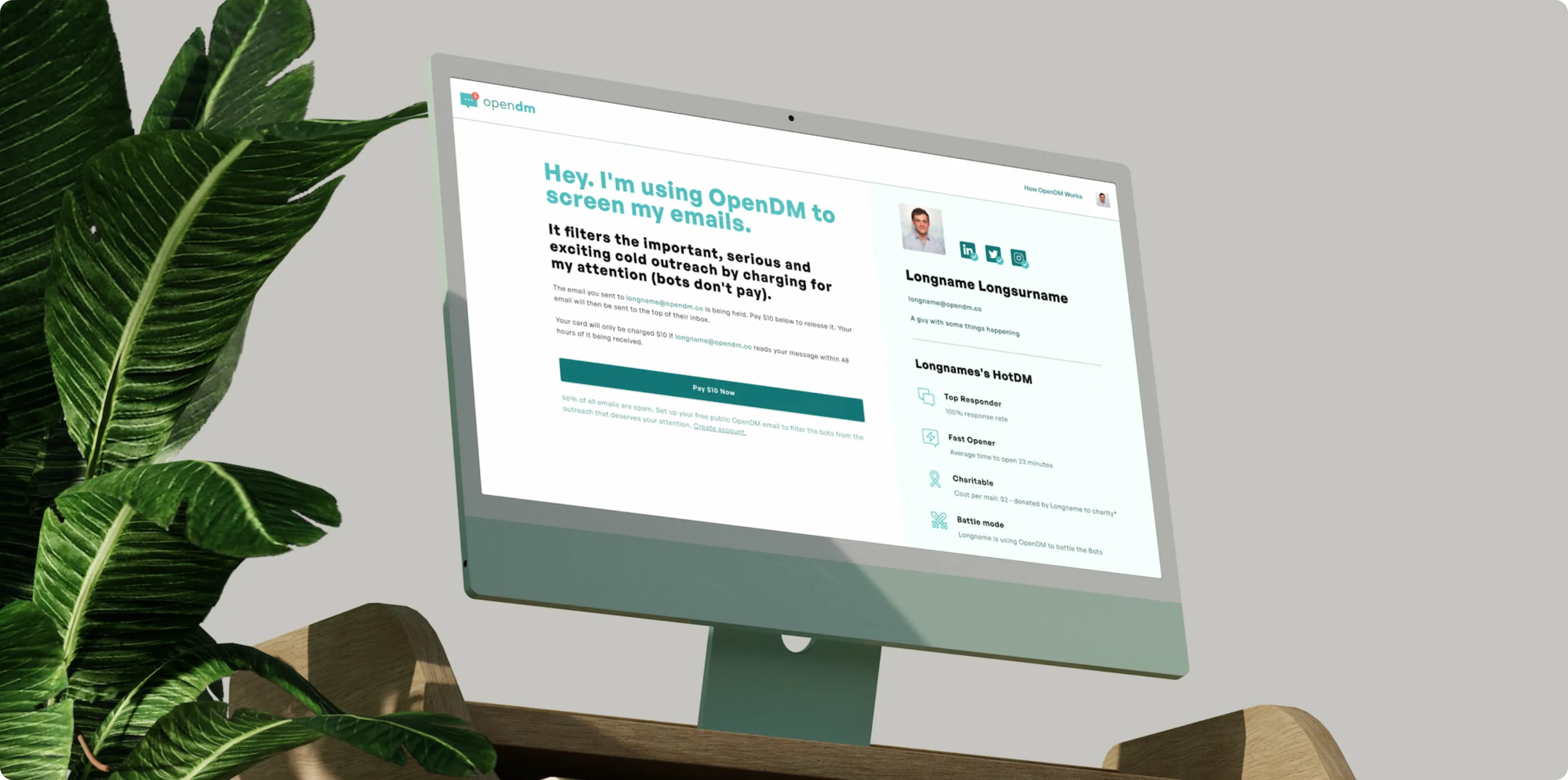
BYO Labs set out to test an idea about attention. Anyone with a following has the same problem — a public inbox fills with spam, bots and cold outreach, so they hide their email address and become unreachable for the messages that actually matter. OpenDM turned that around. You publish one OpenDM address on every social profile you have, and you set a price. Someone who wants to reach you agrees to your fee before their message is forwarded, and you are paid for each message you read within 48 hours of it arriving. Your real address is never exposed, and you can send your fee to charity instead of keeping it. The pitch on the home page put it plainly: make people pay you to reach you. The audience they were aiming at was the influencer crowd, the people whose inboxes are worst affected and whose attention has a market price.
BYO Labs did not want a finished company. They wanted an answer, which meant getting a working product in front of real people quickly enough to learn something from it. Bitcube built it and kept it running.
The Challenge
Nothing existed at the start — no cloud account, no domain, no code — so the entire foundation had to be laid before a single feature could be tried, and it had to be laid in days rather than months because the point of the exercise was speed to market. The thing being tested was a money flow, which meant it could not be mocked: strangers had to be charged for real and creators had to be paid out for real, with identity and tax handled by somebody qualified to hold that risk. The mechanism itself sat in the hardest part of email, receiving mail sent to arbitrary addresses, holding it back until payment cleared, then forwarding the original message intact and proving afterwards that a human had read it. Real people's private correspondence would pass through that pipeline from the first day it was public, so privacy and spam handling could not be deferred on the grounds that this was only an experiment. And the audience's main network was outside anyone's control: Instagram would not permit sign-in through its API, cutting off the verification route the product was designed around. Finally, an experiment is only worth running if it reports back, so the product had to be measured from the moment it went live.
Our Solution
Phase 1 — A cloud platform from an empty account, in one week
Between 30 June and 10 July 2023 the whole environment was stood up from nothing: the AWS account and billing, Route 53, SES for mail, Lambda, SQS, ECS and ECR for the containers, a load balancer and certificates for the live and development domains. Deploy pipelines to three environments — development, staging and production — were running by 5 July, so every later change reached a real environment the day it was written.
Phase 2 — The product surface, built from the design concept
The front end was built on Next.js 13 and Tailwind from a designer's Adobe XD concept, broken into reusable components before anything was assembled. That gave a public profile page at each member's own username, a sign-up flow verifying social accounts across six providers, and an earnings calculator turning a person's following and weekly mail volume into a monthly range they could share. The calculator sold the idea to the sceptical; it did not run the product.
Phase 3 — The paid-mail loop, the part that had to be real
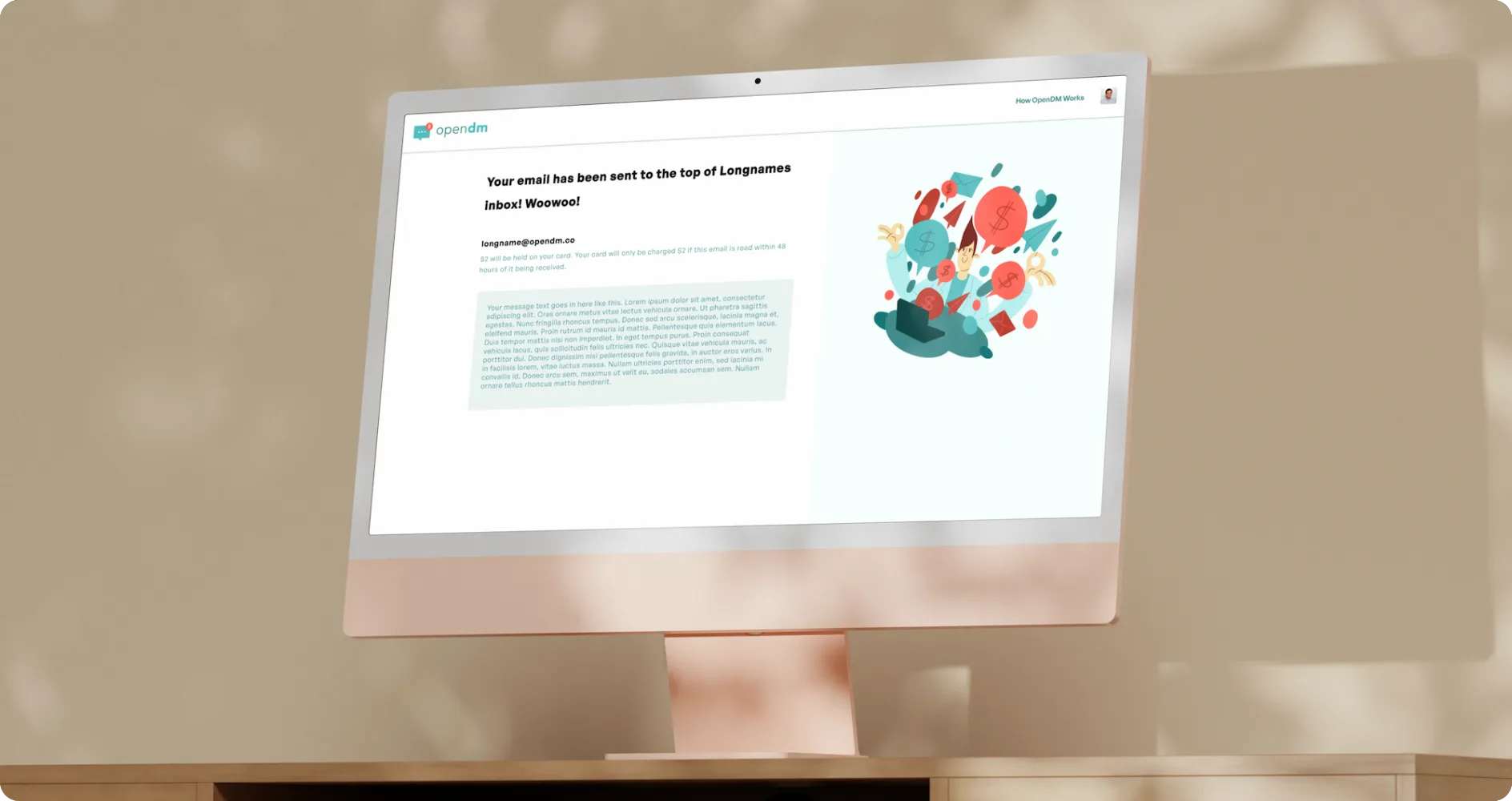
Mail to an OpenDM address is received by SES and handed to a Lambda. If the sender has not paid, the function replies with the recipient's fee and records a payment intent holding the price, the charity flag and an expiry. Once Stripe confirms payment, the original message is forwarded to the member's own inbox, untouched apart from a tracking pixel and a read-receipt link valid for 48 hours. Any read receipt the sender had already attached is stripped first, so the sender learns nothing about the member's habits. Every open, read and reply is timed.
Phase 4 — Getting the money out again
Payouts run through Stripe, which carries the onboarding, identity and country rules so the experiment never held that risk itself. A member can take the fee or send it to charity.
Alongside the build, the product was wired to report on itself: Google Analytics 4 on 4 August, Microsoft Clarity on 30 August, load tests against the live API, and health checks, error reporting and Slack alerts. That instrumentation set what got built next. The client could see dead clicks piling up on the home page, which became an A/B test of four headline treatments, and a slider people fought with was replaced by a dropdown. Through September the common components were pulled out one at a time into a library documented in Storybook. In October, when Instagram refused sign-in, the team prototyped plain URL entry rather than lose the network.
Key Features
- ✓Paid inbox — senders agree the recipient's fee before a message is forwarded
- ✓Public address, private inbox — the member's real address is never exposed
- ✓Read receipts on a 48-hour window — members are paid for attention, not delivery
- ✓Own price or charity — the fee is set per member and can be donated instead
- ✓Six social sign-ins — Google, Facebook, GitHub, LinkedIn, Twitter, Instagram
- ✓Stripe payments and payouts — identity, tax and onboarding carried by Stripe
- ✓Earnings calculator — a shareable estimate from following and mail volume
- ✓Instrumented from day one — GA4, Clarity, load tests and Slack alerting
The Results
BYO Labs got what an experiment is for: a working product in market, quickly. The complete loop — inbound mail, payment, forwarding, read receipt and payout — was running by the first week of August 2023, five weeks after the first line of code, on infrastructure that had not existed at the end of June. The platform ran across three environments with automated deploys throughout, so changes reached real users the day they were made.
Money moved in both directions without BYO Labs ever holding the risk of it, and private mail passed through the system untouched, with the sender learning nothing about the person they had paid to reach.
The product also reported back. Analytics and session recording were in place within weeks, and the behaviour they showed set what changed next: the home page headline went to an A/B test with four variants because visitors were clicking things that were not links. When Instagram closed off sign-in, a fallback was prototyped inside a fortnight rather than losing the main audience.
In October 2023 BYO Labs chose to stop, and the whole thing switched off in one go. The product, the component library and the infrastructure it ran on were all left intact. Restarting it is a decision, not a rebuild.
Client
NAME
BYO Labs
INDUSTRY
Consumer Tech, Payments
Services
Tech Stack
Ready to Start Your Project?
Let's talk about your goals and find the best path forward together.
Get in Touch