
Case Study
Slinger
A hiring platform that refuses to ask for a CV. We built the app it runs on, and got it shipping every month.
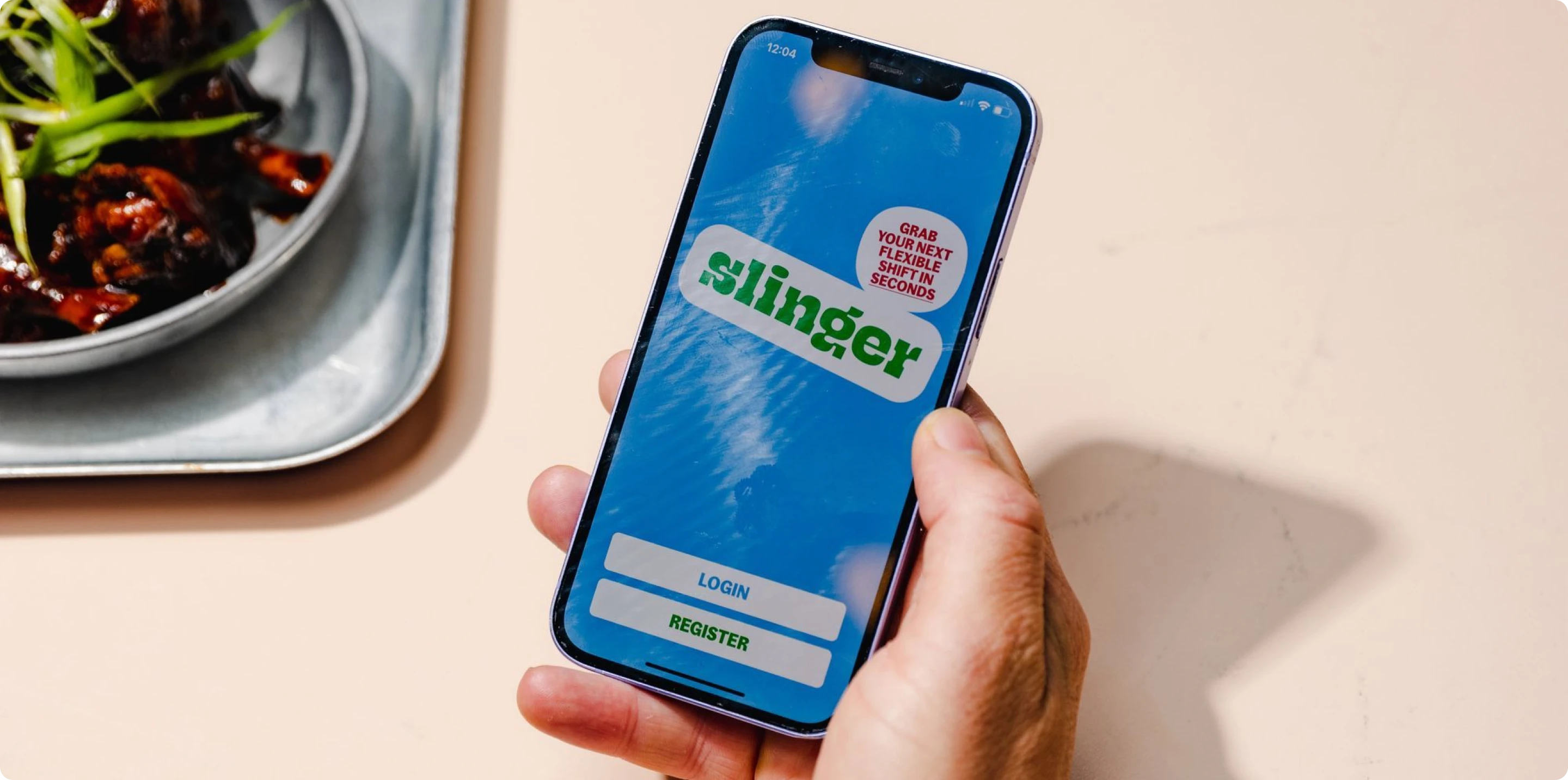
About Slinger
London hospitality runs on gaps. A bartender calls in sick at five. A kitchen is two porters short on the busiest Saturday of the month. The rota was fine yesterday and it isn't now.
Slinger closes those gaps from a phone. Businesses post the shift, freelancers claim it, and everyone gets on with service. The people who take the work are called Slingers: bartenders, baristas, chefs, waiters, kitchen porters, cashiers and team leaders. Every job on the platform pays at least the UK's Real Living Wage, because Slinger is a Living Wage partner and won't list anything less.
What makes Slinger different is what it throws out. Its own campaign is called “R.I.P, the CV.” In place of a work history, a Slinger records a short video introduction and builds a profile out of what they can genuinely do. It's a fairer test of a hospitality worker than a page of dates, and it's a harder one to build software for.
Slinger raised £500,000 in pre-seed funding in October 2023, led by Fuel Ventures, with Ufi Ventures, Cornerstone Partners, the Resolution Foundation and the Google for Startups Black Founders Fund on the round. Six weeks later, Bitcube took ownership of the freelancer mobile app on iOS and Android: the surface where every promise in that pitch deck had to actually work.
The Challenge
A funding round buys time, not a product. Slinger had raised on a claim about hiring without CVs, and the freelancer app was the only place that claim could come true. If a chef couldn't sign up, record a video, prove their right to work and claim a shift from their phone, there was nothing underneath the round but intent.
The app we inherited had been in development elsewhere for roughly a year. It didn't build. Dependencies had drifted apart, the iOS install step was broken, and files needed patching by hand before the thing would even start. Nobody's roadmap survives that. The first week went on making the app compile, not on anything a Slinger would ever see.
Then there was what the app was actually handling. A hospitality shift carries a right-to-work check, a conduct policy with real consequences, and a payment to a self-employed person at the end of it. Log the wrong arrival time and you haven't shipped a small bug — you've taken money off someone who worked for it. Every one of those flows had to hold up for a freelancer standing outside an unfamiliar venue, on a weak signal, four minutes before service. That setting forgives nothing slow and nothing ambiguous.
And the app was one product of three. Slinger owned the business-facing web app, the API behind both, and the design language. Neither side could move the shared contract on its own, and our releases had to land inside the platform's rhythm rather than our own. Two months in, a full rebrand arrived. Every screen already built had to be redone while the feature roadmap carried on at full speed, because a startup that stops shipping to repaint doesn't get the quarter back.
Our Solution
We don't hand over developers and wait for instructions. We took the app as our product, made the engineering calls that came with it, and answered for what shipped.
Phase 1 — Fix the floor before building the house
We started where nothing shows. Dependencies updated, the iOS install step repaired, and a hard clear-out of components, screens, styles and login logic that had stopped earning their place. For the first time, the app ran from a fresh clone. Then we rebuilt what actually governs delivery speed: navigation restructured into a stack per area of the app, a shared component and theme layer so changing a button means changing one file, and a clean separation between server data in a query cache and app state in a single store. No freelancer will ever notice this work. Every release that followed was faster because of it.
Phase 2 — Take a rebrand on the chin
Slinger rebranded in early 2024 and the app had to follow everywhere at once: onboarding, tab bar, shift cards, buttons, backgrounds, Android as well as iOS. We shipped it as version 2.0 without pausing the roadmap. Crash reporting went in the month after, which changed the terms of every release since. A failure in the field became something we were told about, not something a freelancer had to complain about.
Phase 3 — Build the thing that replaces the CV
Strip out the work history and something has to earn a business's trust instead. A video introduction is recorded in the app and tracked to completion, so nobody is left guessing whether it counted. Around it sits everything a business wants before letting a stranger onto its site: job roles and claimed skill levels, previous experience, references, uploaded certifications, availability, emergency contacts, and right-to-work verification through Yoti. Each of those is a gate between a Slinger and their first paid hour, so each one had to be completable on a phone, resumable when a bus arrives mid-form, and honest about what's outstanding. A required-steps view tells a freelancer exactly what stands between them and work. Onboarding ends with the code of conduct signed on the phone, the same code the strikes system later enforces. Underneath all of it, a continuous refactor consolidated icons, images, buttons and shared values onto single implementations and deleted what had been superseded. The app got smaller as it got bigger. That is not an accident.
Phase 4 — Get onto site, and get paid
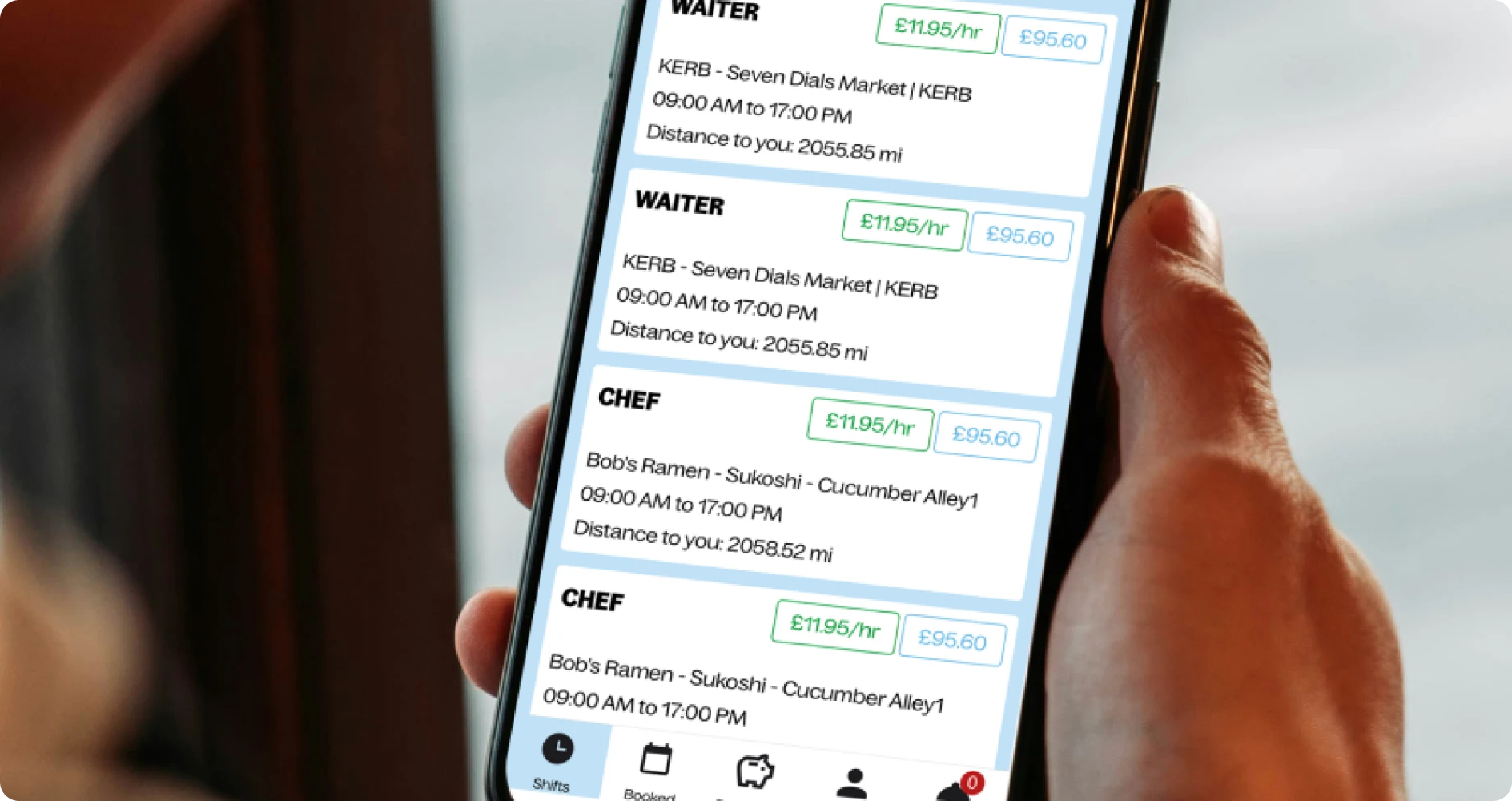
The shift lifecycle is where this app earns its keep. A freelancer finds work in a feed filtered by role, by date and by a distance radius they set themselves, with every shift showing how far away it is. Taking a shift, cancelling within policy, accepting or declining an invitation: all in the app. Arrival is verified on site — whoever is running the shift holds a code, the freelancer scans it with the camera, and that scan, cross-checked against the device's own location, starts the shift and records the arrival time. At the end, the freelancer confirms their hours and rates the business, which pushes a timesheet to the business to confirm before wages release. Where conduct falls short, the strikes system shows a freelancer precisely what has been recorded against them and lets them appeal inside the app instead of over email. Payments close the loop: upcoming payments are listed, and a freelancer triggers their own payout rather than waiting on someone else's Friday.
Phase 5 — Turn a shift into a hiring process
Trial shifts are the feature Slinger sells to a business that wants to hire properly and doesn't trust an interview to tell it much. The business publishes a job description with the wage, contract and start date attached. A freelancer who takes the shift answers screening questions inside a ten-minute window before it's confirmed; miss the window and the shift returns to the pool. One day on site, and both sides know far more than any interview would have told them. The closing months went into redesigning the surfaces freelancers touch most: shift cards, open shifts, booked shift details, completed shifts, trial shifts and notifications.
Key Features
- ✓Video introduction recorded in-app and tracked to completion, the CV replacement itself
- ✓Right-to-work verification through Yoti, built into the profile rather than bolted beside it
- ✓Work profile covering roles, skill levels, experience, references, certifications and availability
- ✓Shift feed filtered by role, date and a freelancer-set distance radius
- ✓Verified on-site check-in: a scanned code, cross-checked against device location
- ✓Hours confirmed by the freelancer, then the business, before wages release
- ✓Two-way ratings after every shift
- ✓Trial shifts: a real shift with a real job offer behind it, screened on a ten-minute timer
- ✓Code of conduct signed on the phone, then enforced by the strikes system
- ✓Strikes with in-app appeal, so a dispute doesn't become an email thread
- ✓Self-service payouts, triggered by the freelancer
- ✓Deep-linked push notifications that open on the screen they're about
- ✓In-app live chat, so a late cancellation reaches a person before it becomes a strike
The Results
Slinger got an app it could ship continuously instead of one it had to work around.
Version 1.1.1 to 2.1 in ten months. Well over two hundred builds cut across iOS and Android. App Store releases on a roughly monthly rhythm, with location-based check-in, shift invites, redesigned onboarding and the payments work each reaching real users within weeks of being built. At the start of the engagement, none of that was possible, because the project wouldn't compile from a fresh clone.
By the end of the engagement, more than 90% of the code running in the live app was ours. Almost nothing of what we inherited survived. That is a rebuild, not a maintenance contract, and it happened without the app ever going dark on the freelancers depending on it. Rebuilding quietly, with no hiatus and no rewrite announcement, is the hardest version of that job and the only one a funded startup can afford.
Slinger's central claim is now something a freelancer can act on, unassisted. Sign up without a CV. Record a video. Prove your right to work. Build a profile from roles, skill levels, references and certifications. Find a shift nearby, take it, check in on site, confirm your hours, get rated, get paid, and challenge a strike you think is unfair. All of it on a phone. None of it needing Slinger's staff in the middle, which is what lets the business grow without growing its ops team at the same rate.
And trial shifts changed what the app is worth to a business. A shift stopped being a gap filled. It became a candidate who has already done the job for a day before anyone signs anything.
Client
NAME
Slinger Staff Limited
LOCATION
London, United Kingdom
INDUSTRY
Hospitality Staffing & Recruitment
Services
Tech Stack
Ready to Start Your Project?
Let's talk about your goals and find the best path forward together.
Get in Touch