
Case Study
Temporall
An organisation's work tools connected into one place, so leaders can audit how work actually happens.

About Temporall
Temporall started in 2018 in the United Kingdom. The idea was that workplace culture could be measured rather than guessed at, and that the data to measure it already existed inside the tools people used every day. The company launched its first platform in March 2019, a real-time culture analytics product that combined survey responses, sentiment analysis and organisational network analysis. In June 2020 it raised a £1m seed round led by Luminous Ventures.
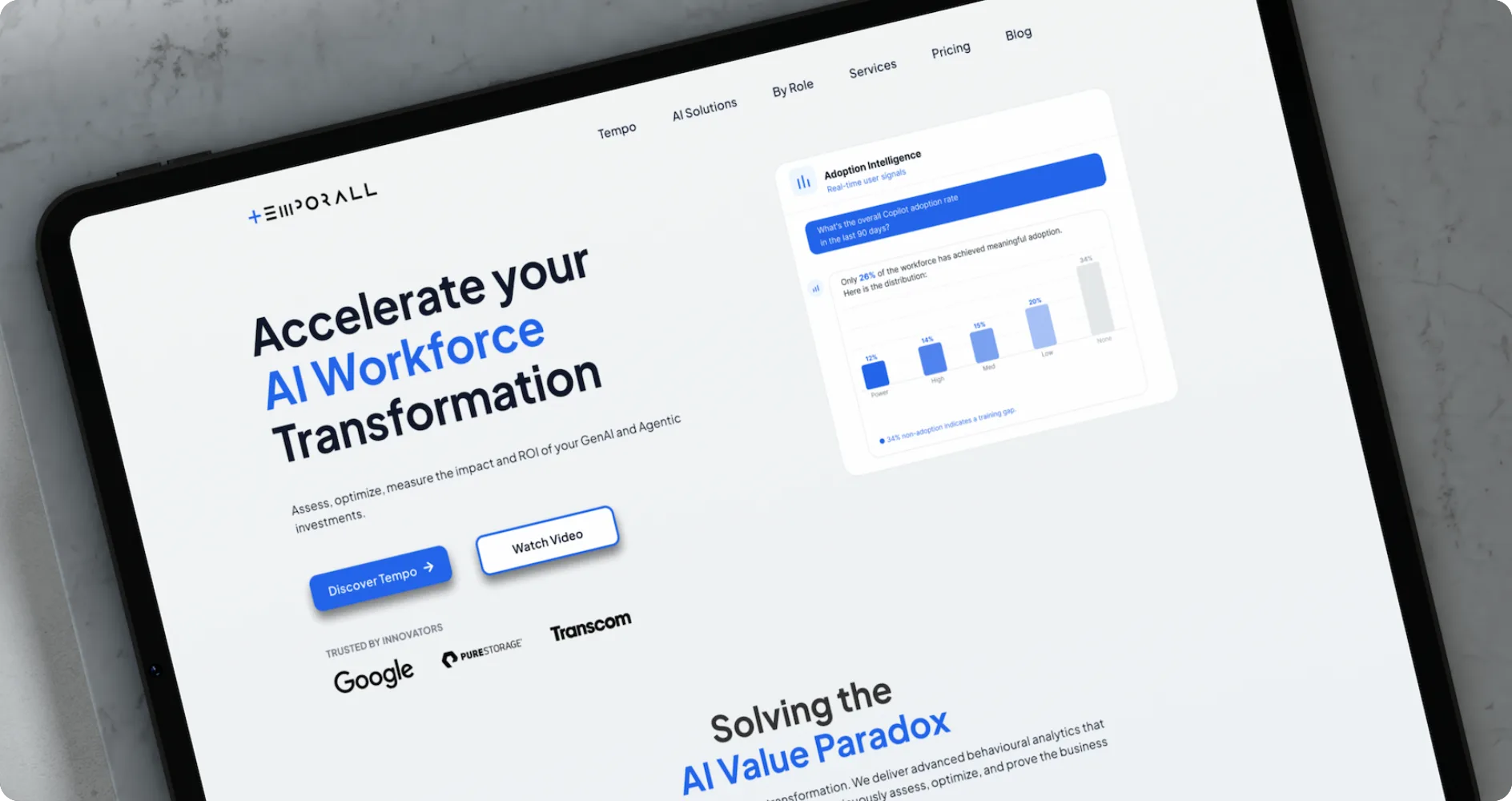
What the company measures has moved with the market. Culture came first, then day-to-day collaboration across Google Workspace, Microsoft 365 and Slack, and now the adoption of AI assistants at work. In January 2026 Temporall launched Tempo, which it describes as the intelligence layer for the AI-enabled enterprise, built to answer what the company calls the AI Value Paradox: heavy spending on generative AI, and little proof of return.
Bitcube has built and run the platform behind that product since February 2018.
The Challenge
Temporall's data had to come from tools Temporall did not own, and each provider changed its APIs, scopes and permission model on its own schedule. The data was the most sensitive an employer holds — mail, calendars, files and messages — so every integration had to be least-privilege and auditable before a customer would connect it. The platform also ran on live customer data from early on, which meant a bad deploy showed up in an executive's dashboard rather than in a test run. The question the product answered kept moving, from culture to collaboration to AI adoption, so the platform had to be re-aimed several times over without being rebuilt each time and without stalling the customers already on it. Enterprise buyers added their own bar: directory provisioning, two-factor authentication, role-based access and control over who could see whose data, all needed before a pilot could start. And organisational network analysis grows expensive faster than headcount does, because the number of possible relationships rises with the square of the number of people.
Our Solution
Phase 1 — A multi-tenant platform to launch on
The first two years built the foundation: an Angular front end, a Node and Express API, MySQL on Google Cloud, and multi-tenancy, roles and organisation management from the start, so one codebase could serve separate enterprise tenants without their data ever meeting. Surveys, a questionnaire engine and Slack and Workplace bots gathered the input. That work carried the March 2019 launch, thirteen months after the first line of code.
Phase 2 — From asking people to reading the work
Surveys only capture what people say about their work, so from 2020 the platform began measuring the work itself. Collaboration data came in from Teams, Slack channels and Workplace. On top of it came topic extraction, sentiment scoring, engagement metrics and demographic breakdowns, and the first organisational network analysis, drawn in the browser with force-directed layout and community detection so an analyst could explore a graph instead of reading a report.
Phase 3 — Depth across the two suites that mattered
Between 2022 and 2023 the integration surface widened until it covered the working day: Gmail, Calendar, Drive, Meet and Chat on Google Workspace, and mail, calendar, drive and directory data through Microsoft Graph. SCIM provisioning, two-factor authentication and role-based permissions went in alongside, because that was the list enterprise security teams asked for.
Phase 4 — Measuring AI adoption
From September 2024 the platform began reporting on Gemini usage against licences held, with BigQuery added underneath to hold the volume that came with it. Microsoft Copilot followed in January 2026. This is the work behind Tempo.
Alongside every phase, the platform was kept current rather than allowed to age. Angular was upgraded in place from version 5 to version 17, one release at a time, and the component migrations were run one component per pull request so the live product never stopped. Six environments — development, QA, staging, pre-release, demo and production — kept that possible.
Key Features
- ✓Multi-tenant SaaS platform — one codebase, separate and isolated enterprise tenants
- ✓Google Workspace integration — Gmail, Calendar, Drive, Meet, Chat and Gemini
- ✓Microsoft 365 and Slack integration — collaboration data via Graph and the Slack APIs
- ✓Organisational network analysis — force-directed graphs with community detection
- ✓AI adoption reporting — Gemini and Copilot usage measured against licences held
- ✓Enterprise access controls — SCIM provisioning, two-factor, role-based permissions
- ✓BigQuery pipelines — collaboration data warehoused for analysis at scale
- ✓Upgraded in place — Angular 5 to 17 across eight years, with no rewrite
The Results
Temporall has shipped continuously since February 2018, and the platform has been upgraded in place throughout rather than taken down and rebuilt.
Temporall can now audit Google Workspace, Microsoft 365 and Slack side by side, which is what the company sells. The data arrives from tools Temporall does not own, and keeps arriving as those providers change their APIs underneath it. Enterprise security teams get the controls they ask for before a single mailbox is connected: directory provisioning, two-factor authentication and role-based access.
The platform has been re-aimed three times without being rebuilt — culture first, then day-to-day collaboration, then AI adoption — and it carried both of Temporall's public launches: the culture analytics product in March 2019, and Tempo in January 2026, eight years apart on the same foundation.
It holds enterprise scale. In April 2025 Temporall announced that its platform had been selected by an enterprise of more than 30,000 employees, working across 29 countries, to report on Google Workspace usage and Gemini adoption.
What comes next is already scoped: organisational network analysis at 100,000 people, SAML single sign-on, and data residency in both the UK and the US.
"I've always tried to select people around me that are really best in class and I've always seen Bitcube as being an extension of my team so I don't really differentiate between the two of them. Bitcube has a way of really fitting in with our philosophy. The Bitcube team is very complementary to our style of work. I see Bitcube as a partner who goes that one step further in terms of looking to be curious with me, in real time and who aren't afraid to make suggestions and take initiative rather than just doing the brief. I am very fortunate to have gotten to know the Bitcube team and look forward to continuing the relationship."
Thomas Davies
Founder & CEO, Temporall
Client
NAME
Temporall
LOCATION
United Kingdom
INDUSTRY
Data & Workplace Analytics
Services
Tech Stack
In the Media
Ready to Start Your Project?
Let's talk about your goals and find the best path forward together.
Get in Touch